
Heard County Busted Mugshots
A mugshot and a booking record are not the same thing. The photo happens at intake. The booking record is the paperwork built around it. Neither one equals a court case. In Heard County, the Franklin Police Department writes the arrest report. The Sheriff's Office builds the jail records once someone arrives. Courts handle charges and outcomes later on.
The Heard County Jail Division runs one 70-bed facility in Franklin. It holds people facing felony and misdemeanor charges. It also boards inmates for other jurisdictions at times. The public pages cover bonds, mail, visitation, and daily operations. No searchable inmate roster, though. That gap matters. A person can be arrested, bonded out, moved, or housed elsewhere and never appear as a current Heard inmate.
The practical flow is arrest report → jail intake → booking record and possible photograph → custody or release → court docket → disposition. Each arrow can move the record to a different custodian. That is why a missing web result cannot prove that an arrest did not happen.
The official jail page is useful for understanding the facility, not for viewing a gallery. Its captured interface shows the type of operational information HCSO publishes rather than a current list of faces. Compare the capture with the official Jail Division page before relying on a current detail.
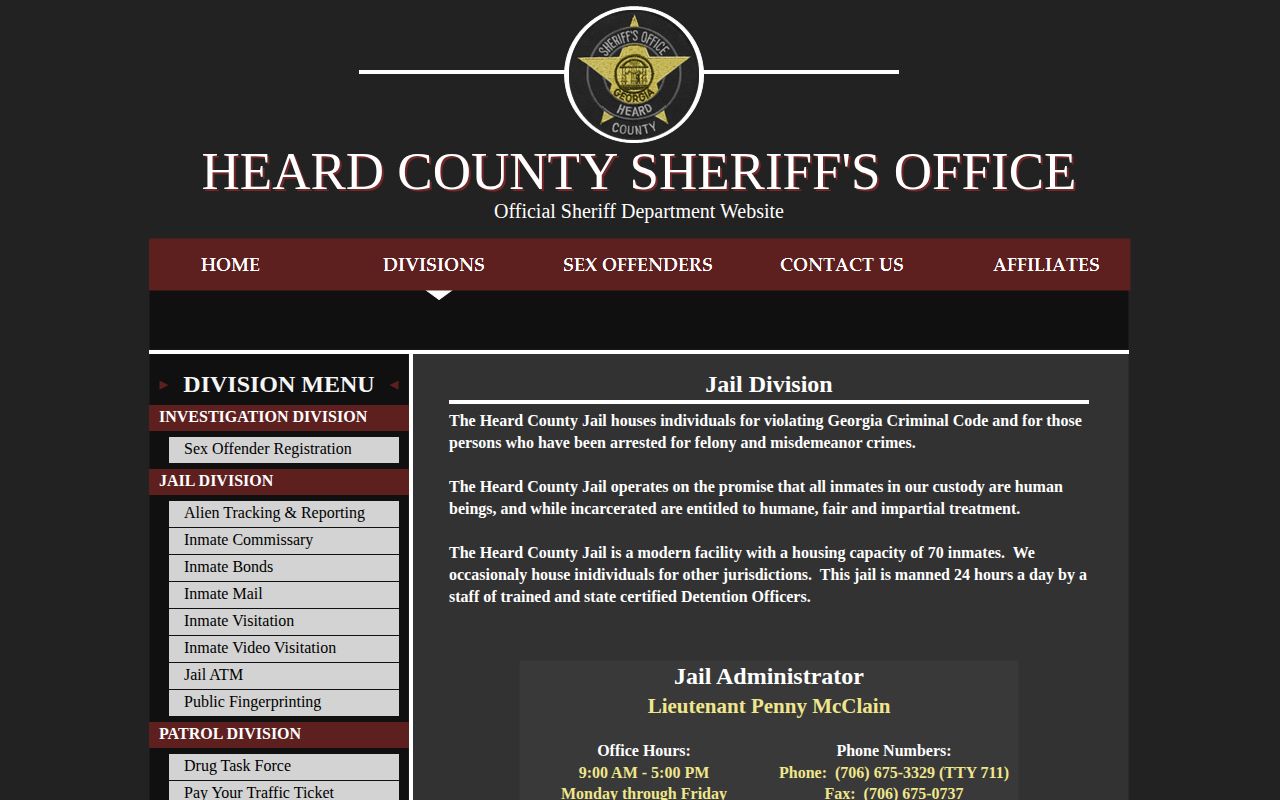
That distinction keeps Heard County busted mugshots tied to a lawful record path. The linked capture is a source interface, not a rehosted booking photo or a live custody count. Recheck the official jail page for changes.
Heard County Busted Booking Records
Heard County does not publish a booking-record schema online. So a records request has to do the work. Name the person, give an approximate booking date range, and specify the exact record series you want. Assume nothing is bundled into one file, either. Medical details, victim information, juvenile material, sealed files, and protected investigative content may be withheld or redacted by law.
| Field | What it can show |
|---|---|
| Name and identifiers | The person listed at intake, with enough detail to reduce a namesake mistake. |
| Booking number | The jail intake reference. It is not automatically the court case number. |
| Intake and release times | When the county record shows entry into custody and a later release or transfer. |
| Arresting agency | Whether the record came from Franklin Police, HCSO, or another agency. |
| Charges as booked and citations | The charges recorded at intake. |
| Bond type, amount, and status | The release condition recorded by the custodian, if maintained and releasable. |
| Booking photograph | An identification image that is subject to Georgia's specific release and posting limits. |
| Court assignment and transfer status | The court or destination connected to the custody record, if those fields exist. |
Each record answers a different question. The arrest report describes the event. Booking covers intake. Bond records deal with conditional release. Jail records track custody, and the court docket shows what prosecutors and judges did afterward. One caution: seeing someone leave the jail tells you almost nothing. They may have bonded out, been transferred, or been released outright. Only the right record says which.
- Booking
- Administrative intake after an arrest or other lawful detention.
- Arraignment
- A court stage where charges and the next steps are addressed; it is not the final outcome.
- Bond
- A court-ordered condition for release while a case continues.
- Disposition
- The recorded result of a charge or case, such as dismissal, plea, acquittal, or sentence.
- Restriction
- A legal limit on specified criminal-history dissemination. It is not the same as deleting every outside copy.
Request Heard County Busted Records
Need a named booking record or photo? The HCSO open-records form is the way in. You describe what you want and set a date range. You can review records, pick up copies, or get them by mail. The office sends a cost estimate before large charges pile up. Delivery is simple. Walk it in during business hours at 11820 Highway 100 North, Franklin, Georgia 30217. Or mail it to Open Records Request, HCSO, P.O. Box 339, Franklin, GA 30217. Email works too: jolinger@heardcountyga.com.
HCSO Records Route
Heard County Sheriff's Office
11820 Highway 100 North
Franklin, GA 30217
706-675-3329
Open-records email: jolinger@heardcountyga.com
Administrative hours: Monday-Friday, 9 a.m.-5 p.m.
- Identify the person and approximate arrest or booking dates. Add the arresting agency, booking number, or release date if known.
- Ask for the intake record and booking photograph as separate items, plus the booking number, times, charges as booked, bond, court assignment, and custody or transfer fields.
- State that electronic copies are preferred and request an estimate before costs exceed the chosen limit. Ask for segregable portions if part of a record is withheld.
- Expect a response within three business days under the local form's instructions, while understanding that this is a response deadline, not a promise of production in three days. HCSO also asks people to allow at least three business days after the incident before requesting.
The form rests on O.C.G.A. §§ 50-18-70 through 50-18-76. Fees follow state rules. The Open Government FAQ from the Georgia Attorney General notes that search and retrieval time past the first 15 minutes gets billed at the prorated rate of the lowest-paid qualified employee. Copies usually run 25 cents per paper page, and agencies favor electronic delivery when it works. HCSO posts no flat mugshot fee. Ask for an estimate instead of expecting a set price.
Tailor the request to the situation. For someone already released, give the likely release date and ask for both intake and release timestamps. If a transfer seems possible, request the destination and transfer date if the office keeps them. If an image is withheld, ask the custodian to cite the specific legal basis. Skip requests for protected medical, juvenile, victim, or investigative material.
Georgia Mugshot Law for Heard County
Georgia's Open Records Act starts at O.C.G.A. § 50-18-70. An agency generally must respond within three business days. If it can't produce records that fast, it must explain the timeline, the expected cost, and any exemption behind a denial. The law never forces an office to invent a report that does not exist. Keep the request narrow. Ask for an existing intake record and photo, and the custodian has a clear job.
Booking photos get special treatment under O.C.G.A. § 35-1-19. An arresting agency generally may not post a mugshot on its own site outside listed law-enforcement uses. The statute also covers requested images that could reach a publisher charging money for removal. A requester may need to sign an affirmation. Lying on one carries its own legal risk. The Georgia Consumer Protection mugshot guidance lays out the publisher rules in plain terms.
Certain outcomes trigger removal rights. Under O.C.G.A. § 10-1-393.5, a covered commercial publisher can be required to pull a photo for free within 30 days of proper written notice. Qualifying outcomes include record restriction, closure with no case referral, a pre-charge dismissal, dismissal or nolle prosequi of all counts, a qualifying conditional discharge, or acquittal on all counts. The notice must carry the identifying details and delivery proof the statute demands. A pending charge is not enough. Plain passage of time is not either.
Georgia draws a bright line at July 1, 2013. Arrests before that date follow one path; those after follow another under the GBI restriction instructions. A restriction, a sealed court file, a corrected GCIC entry, a photo still held by an agency, a commercial archive, and a search result are six different things. Removing one copy does not touch the rest. Any legal outcome should be pinned to the exact case number and the specific charges it covers, never to a broad promise that every trace will vanish.
The current HCSO website posts no official photo roster. That gap fits a request-based release process, though it cannot tell you why the sheriff's office publishes things the way it does.
Busted in Heard County: Bond and Release
A judge sets bond in Heard County. The sheriff does not. The HCSO bond instructions list four routes: cash, property, out-of-county property, or a professional bond from an authorized agent. Cash bonds during business hours take USPS money orders or cashier's checks drawn on local Heard banks. After hours, the options narrow. Only USPS money orders or cash work then. Personal checks, business checks, and bank cards are not accepted.
| Release route | Heard County detail |
|---|---|
| Cash bond | Follow the current HCSO instructions and confirm hours before traveling. |
| Property bond | Heard County property and every person named on the deed or tax receipt may be required, along with the listed records and photo identification. |
| Out-of-county property | The sheriff where the property lies prepares the bond and sends it in a sealed package on that county's letterhead. |
| Professional bond | Use a company registered and authorized in Heard County. Detention staff do not recommend a company. |
Release mechanics explain why a person can disappear from a current-custody view even though the intake record remains. Heard has no public roster to show that transition, and a bond page cannot predict the exact release time. For a record of what happened, ask HCSO for intake and release fields rather than treating a bond instruction as a live custody result.
The bond page screenshot is linked to the official source so readers can check current instructions before relying on an older summary. Read the current HCSO bond instructions before taking action.
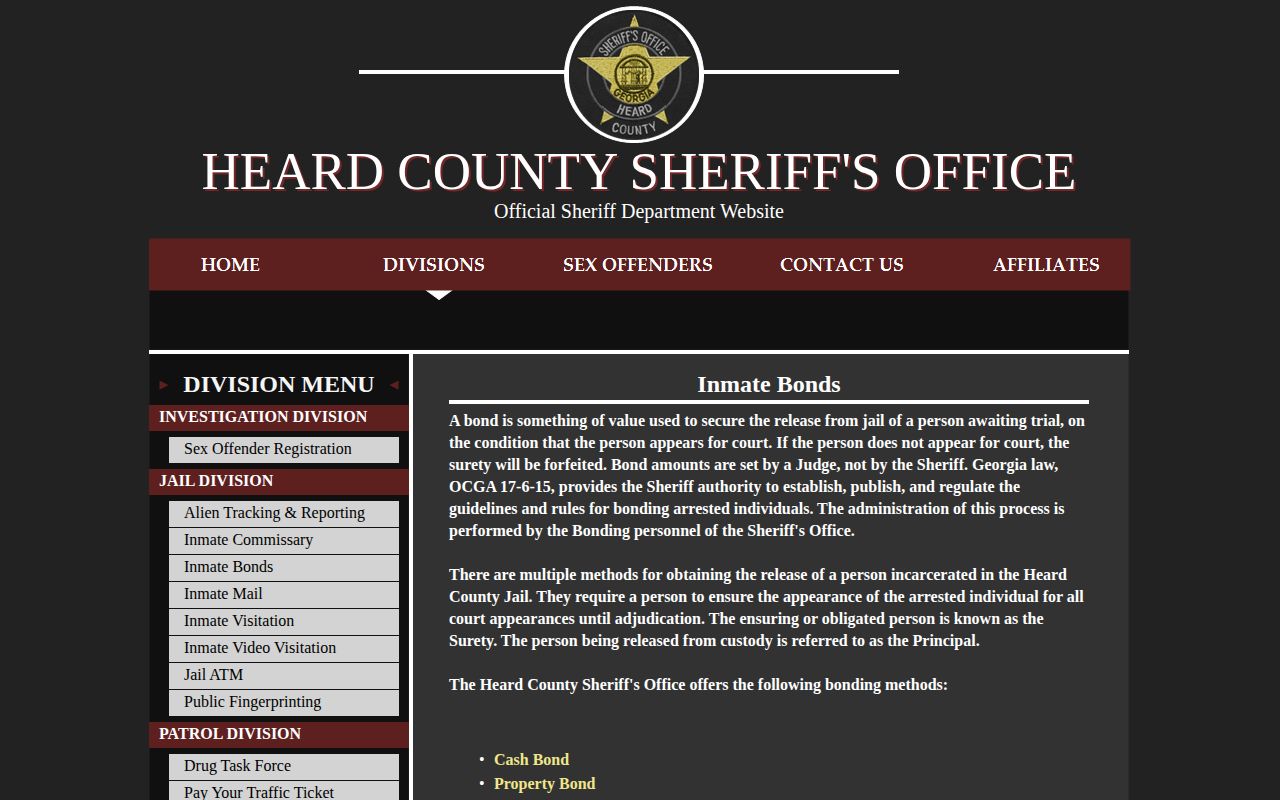
This is a release-process reference, not a list of people who were booked or released. A court order and the jail's record control the particular case. Confirm the details on the same HCSO bond page.
Heard County Busted Photo Posting Limits
O.C.G.A. § 35-1-19 defines a booking photograph as one made by an arresting agency for identification or during jail processing. Two rules sit inside that law. Keep them separate. A sheriff can hold an image internally without ever posting it on a public roster. A records requester, in turn, may get an answer tailored to the specific facts rather than an automatic release.
The official Georgia consumer page matters too. A commercial publisher's later no-fee removal duty is separate from the sheriff's original custody record. A photo sitting on some unofficial page proves nothing about current custody or any court result. When a qualifying outcome is documented, follow the publisher's lawful process and keep proof of delivery. Steer around any service charging to take an image down.
The law's purpose and its exceptions belong to the record custodian and a qualified lawyer. A public-record request should describe the intended use accurately. Include any required affirmation. Juvenile images and other protected material must never be sought as if they were ordinary adult booking records.
Heard County Juvenile Records
Juvenile law-enforcement files are no place to hunt for Heard County busted mugshots. O.C.G.A. § 15-11-708 generally demands separation and confidentiality, though transfer, public-hearing, security, best-interest, and other statutory exceptions exist. A young person prosecuted in superior court as an adult raises a different legal question entirely. Even that narrow doorway does not open a public juvenile-photo search.
An adult name match proves nothing. Ask the responsible agency or court about the exact record category. Accept a lawful redaction or withholding when it comes.
Find Heard County Busted Mugshots
Heard County has no verified public roster. No same-day booking feed exists. No searchable booking-photo interface either. The workable approach is a custody-state ladder. It works outward from the office that created the record. A web search may surface an old story. Still, only the creating agency can confirm what the record actually says.
- Just booked or possibly in county custody: call HCSO at 706-675-3329 and ask a narrow, time-sensitive question about present custody. A phone answer describes that moment only.
- Recent or released county booking: use the HCSO written form for a named intake record and photograph, subject to O.C.G.A. § 35-1-19 and any redactions.
- Case status: check the Heard Superior Court clerk and the Georgia Courts e-access route for the docket and disposition. A booking number may not retrieve a court case.
- State prison: use the Georgia Department of Corrections offender locator if the person was sentenced to GDC custody. It is not a county-arrest feed.
- Federal or immigration custody: use the federal locators described below and keep federal criminal custody separate from civil immigration detention.
- News or an unofficial archive: treat the result as a lead. Record its publication date and jurisdiction, then verify it against HCSO, the police department, the court, or another owning office.
That ladder guards against two common mistakes. An empty roster result does not mean no arrest happened. The reverse is true too. An old archive entry does not mean anyone sits in custody right now. Plenty of things can shift where a record lives. Bond release, a transfer, data lag, a restriction, or an arrest by another jurisdiction all move it.
Where Heard County Busted Mugshots Appear
Start with official sources. The HCSO phone line and records form handle the county booking record, the courts track case progress, and GDC lists sentenced state prisoners. Local news can fill in the timeline. An unofficial archive may hold a dated entry that no longer reflects live custody, so treat each source as one piece of the picture.
| Channel | Photo or record? | Official? | How to use it |
|---|---|---|---|
| HCSO roster | No public interface verified | Would be official, but none is published | Call HCSO or use the records form instead. |
| HCSO booking feed | No same-day or multi-day feed verified | No | Do not promise a refresh window or archive. |
| HCSO records request | Named intake record and photo may be requested | Yes | Use the form, date range, and lawful request details. |
| Heard court records | Docket and disposition, not a jail photo | Yes | Use the clerk or Georgia Courts e-access for what happened next. |
| GDC offender search | Photo if available on a state-prison profile | Yes | Only for the state-correctional custody slice. |
| Local and regional news | Images vary; no complete feed | No | Use a dated story as a lead and check its named source. |
| Mugshots.com Heard category | Publisher archive observed at research time | No | It is unofficial, may be stale, and cannot prove present custody. |
One verified county-local aggregator exists: the Mugshots.com Heard County category. Its publisher-side archive has listed 251 records. Those are archive entries, not current inmates or convictions. Busted Newspaper, Recently Booked, Arrests.org, and Mugshots.zone show no verified Heard County section. A missing category proves nothing about whether an arrest occurred.
Heard Citizen and regional television sit in the news landscape. They are not a custody roster. A story may run an agency handout, a file photo, a scene image, or nothing at all. For the outcome of any case, the court is the proper source.
Heard County Jail Roster: No Portal
The Heard County Sheriff's Office offers no online inmate search. Its Jail Division pages carry no lookup form. No vendor link, no photo results, no booking archive. So there is nothing to verify on cadence or lag. Any site promising a live Heard County jail roster is filling a gap the county left empty. Treat such promises with real doubt.
| Roster item | Heard County finding |
|---|---|
| Official portal | None verified on the current HCSO site. |
| Search fields | None publicly documented. |
| Booking photos | No official online display verified. |
| Refresh cadence | Not applicable. Do not promise a same-day or weekly window. |
| Persistence | Not applicable online. Ask HCSO about a historical record. |
| Fallback | Call 706-675-3329 for a time-sensitive custody question, then use the written request for a durable record. |
- Confirm the official HCSO contact details before relying on a search-engine result.
- Ask whether a named adult is presently held, without assuming the telephone answer will include every field.
- Follow a verbal check with a dated records request if an intake or release record is needed.
One caution deserves its own line. A search-engine domain advertising a Heard County roster has no connection to the sheriff's office. Sending a reader there would be a mistake. Treating its claims as proof that someone sat in county custody would be one too.
Busted Last Night in Heard County
Heard County has no verified official feed. Nothing covers same-day, 48-hour, 72-hour, weekly, or released bookings. No archive exists either. So phrases like "today's arrests" or "last 48 hours" promise data the sheriff's office never publishes. Honest sites avoid them.
| Window | Verified official result | Best fallback |
|---|---|---|
| Same day / 24 hours | None | Call HCSO for present custody, then request the record. |
| 48 hours | None | Use a date-bounded HCSO request if the record exists. |
| 72 hours / weekly | None | Do not confuse the HCSO three-business-day request instruction with a feed window. |
| Archive | None | Ask HCSO which adopted retention series covers the booking. |
The HCSO request form asks for at least three business days after an incident. That guidance covers how requests get handled. It says nothing about booking timing, internal records, or when a photo might surface. A returned record set is not a running arrest log.
Weekend and holiday timing can't be measured where no feed exists. If someone has been released, give the approximate release date. Request both intake and release fields. For a transfer, ask whether the destination facility and transfer date are kept on file and can be released.
Busted to GDC: State Offender Photos
The Georgia Department of Corrections Find an Offender locator covers people in or historically associated with state correctional custody after a sentence. It does not list everyone arrested or held temporarily at Heard County Jail. A GDC profile is a correctional record, not proof of a new Heard arrest.
GDC says an offender photograph displays automatically when one is available, but its FAQ says many photos have not been uploaded. A useful search method is the first four letters of the last name with all offenders selected instead of active only. Completed First Offender records are not published. Compare identifiers carefully because a same-name result is not identity proof.
For a historical or clearer releasable image, ask the GDC records office with the full name, GDC number, and approximate incarceration dates. The locator directs users to confirm through written correspondence with Inmate Records and Information, P.O. Box 1529, Forsyth, GA 31029. A photo request is not a guarantee because institutional and protected information may be withheld.
The GDC interface screenshot is linked to the state source and shows the offender-search channel, not a county booking roster. Open the official GDC locator for the current search interface.
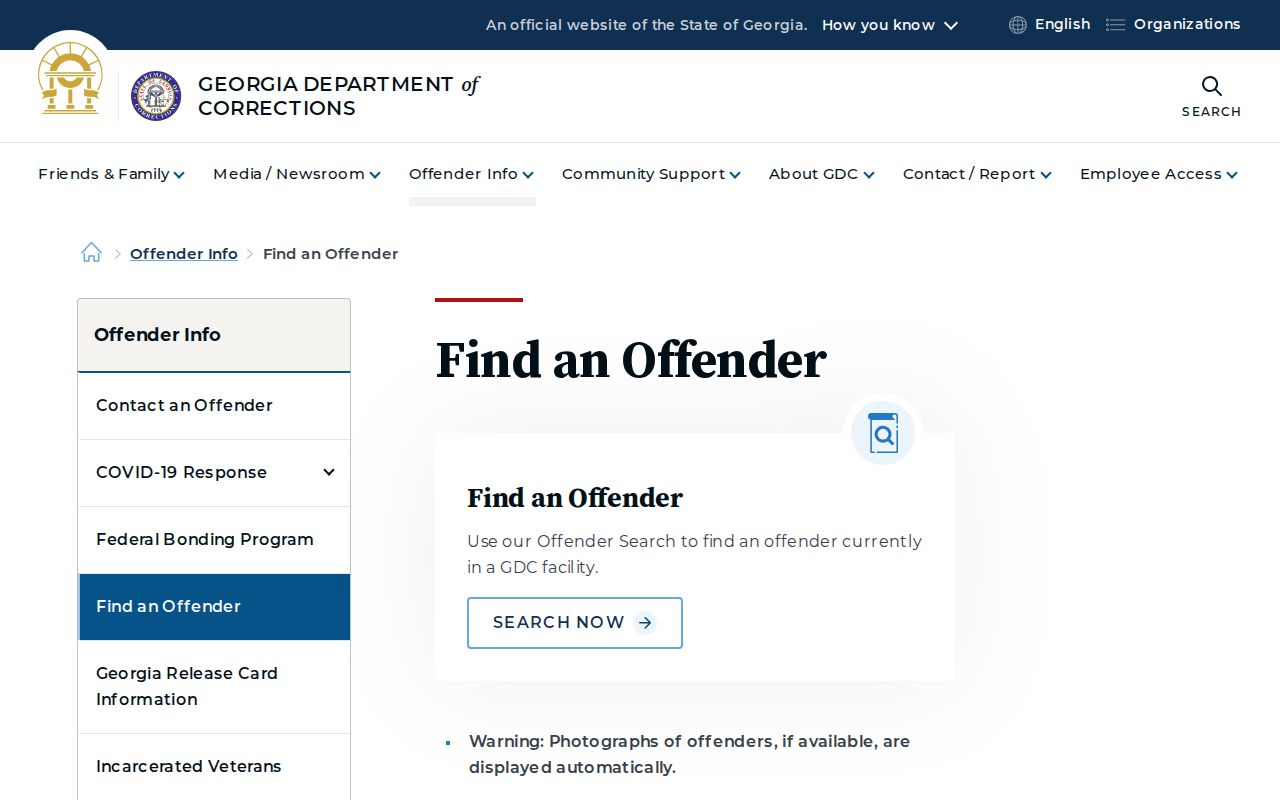
When a person moves from county detention to state prison, the custody system changes. Keep the county booking record, court disposition, and GDC profile as separate records. Use the GDC source only for the state-correctional portion.
Booked vs Released in Heard County
Custody status and record availability are two different questions. A jail's answer today reflects one moment. A booking record may describe a stretch of time already past. A court file can outlast jail visibility by years. The table keeps those states apart.
| Custody state | Likely official source | What the result means |
|---|---|---|
| Just booked or still in county custody | HCSO phone line; no public roster verified | A current answer may confirm custody at call time. It is not a conviction. |
| Released on bond or otherwise released | HCSO intake and release records by request | The person may no longer be in jail, while the booking record remains a separate record. |
| Case moving through court | Heard Superior Court clerk and Georgia Courts e-access | The docket and disposition address what happened after booking. |
| Sentenced to state prison | GDC offender locator or GDC records request | A state-correctional profile is not a new county arrest. |
| Federal or immigration detention | BOP or ICE locator | Federal criminal custody and civil immigration custody are separate from HCSO. |
For any result, write down the source, the date, the full name, and the jurisdiction. A missing record can mean a release, a transfer, a correction, a restriction, a lag, or a different custodian. Note: a gap in the records is just that, a gap, and no conclusion should be drawn from it.
Heard County Court Dispositions
The Heard Clerk of Superior Court is at 215 East Court Square, P.O. Box 249, Franklin, GA 30217, phone 706-675-3301, with office hours Monday-Friday 8:30 a.m.-5:00 p.m. The official clerk page and the Georgia Courts e-access gateway are the principal disposition routes. The gateway lists Heard Superior and redirects to an outside provider that may require an account.
Use a case number when known. Otherwise compare full name, arrest or booking date, and filing context. A booking number belongs to jail intake and may not retrieve a case. Felony accusations and superior-court dispositions belong with the clerk; misdemeanors, ordinance matters, warrant applications, and preliminary proceedings can begin elsewhere. The Heard Magistrate Court directory number is 706-675-3002.
The court record can show an accusation, indictment, amendment, dismissal, dead docket, plea, trial result, or sentence. A nolle prosequi means the prosecution did not proceed on a count; it must not be described as a conviction. A pending charge must not be described as resolved. The Georgia Bureau of Investigation explains that missing or wrong final dispositions should be addressed with the owning court.
The court gateway screenshot points to the actual research route. It does not display a booking photograph, and it does not replace a clerk confirmation where a namesake or incomplete docket creates doubt. Check the official Georgia Courts e-access gateway for the current route.
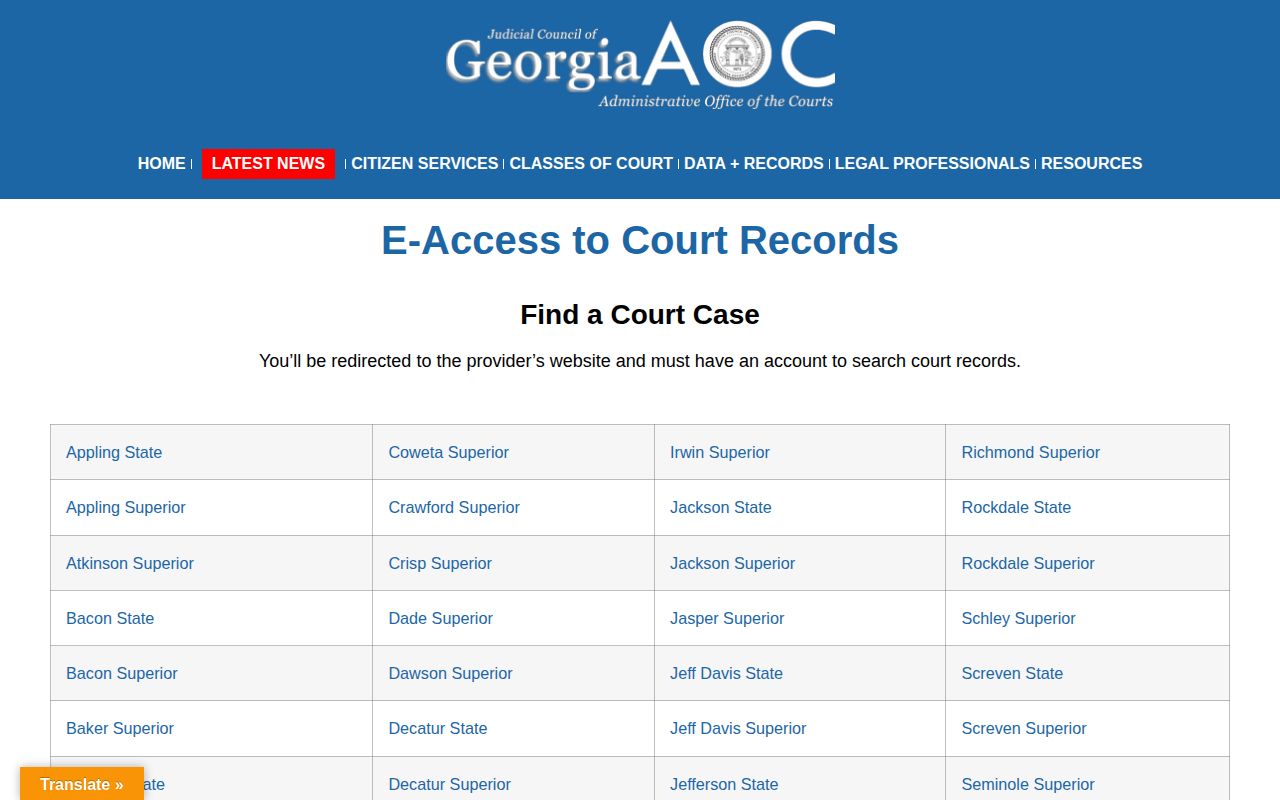
A final judgment, restriction order, or correction should be identified by its case number and covered charges when separate custodians are contacted. The court gateway remains a search route, not a substitute for clerk confirmation.
Heard County Alerts and Apps
Don't expect an HCSO inmate-search app. The closest tool is Pay Tel Connect, which handles video visitation with someone in the jail. Searching, booking photos, and release archives fall outside what it does.
Franklin posts emergency alerts through CodeRED, a warning system run with Heard County Emergency Services. It flags dangerous situations in the community. It won't notify you about bookings or releases. Sheriff's social media sometimes mentions an investigation or asks for tips, but those posts come and go and never add up to a full arrest log.
Heard County Federal Custody Records
For federal inmates, the Federal Bureau of Prisons locator reaches back to 1982 and refreshes daily. Search by name or federal number. Results can show a register number, age, race, sex, release date, and location. There's no booking-photo field. A hit might also mean pretrial detention, a material witness hold, or civil contempt.
The ICE Online Detainee Locator tracks current ICE custody plus some CBP holds lasting over 48 hours. You'll need an A-number with a country of birth, or an exact name and country with an optional birth date. People under 18 can't be searched, and no mugshot function exists. Note that immigration detention is civil, not criminal.
USMS photographs people during federal processing, yet it offers no public prisoner locator or photo gallery. A FOIA request may come back denied. None of these federal tools creates a Heard County booking record or fills a gap in the HCSO files.
Heard County Booking Archives
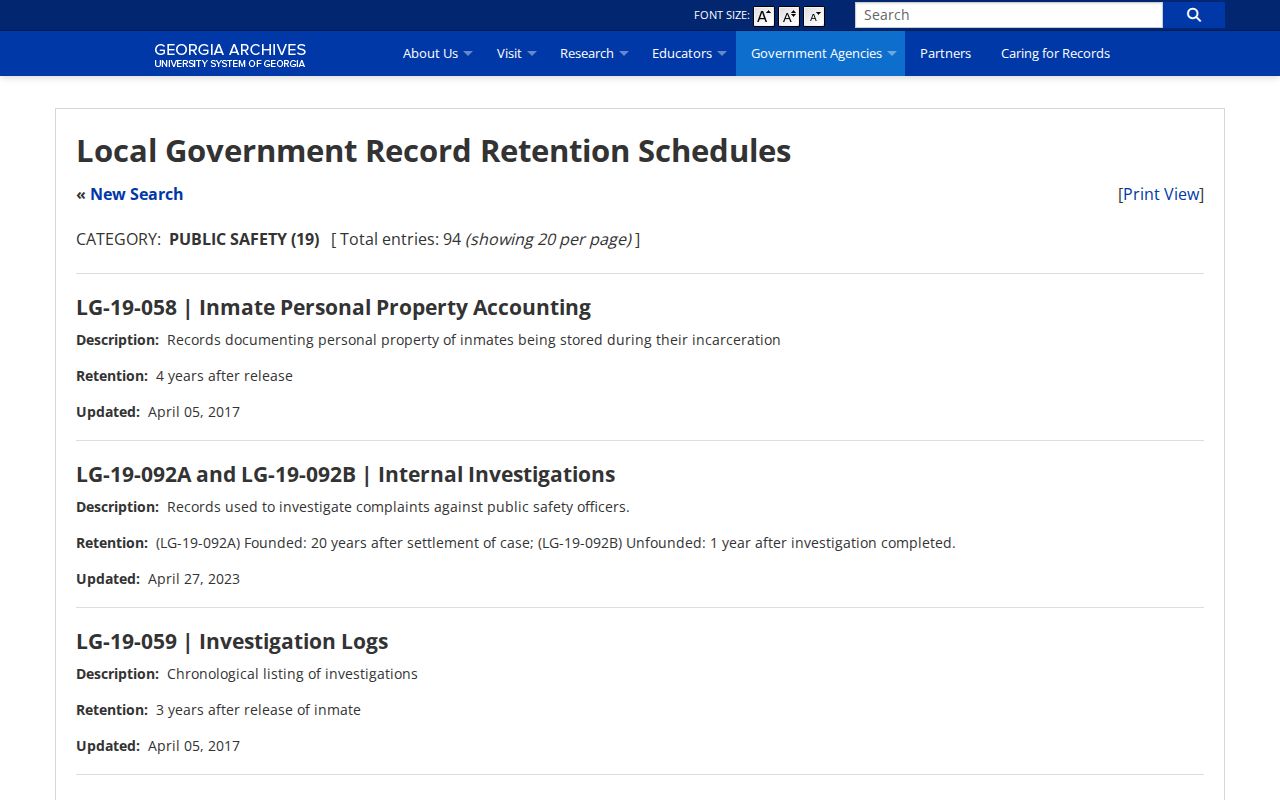
Georgia Archives schedule LG-19-060 lists jail booking records and associated personal, medical, fingerprint, and booking data for five years after settlement. The schedule does not expressly name the booking photograph, and “settlement” needs to be confirmed with HCSO for a particular record. Ask HCSO which adopted series covers the image, what event starts the period, and whether a legal hold changes disposition.
A retention schedule is not an online publication window. It does not promise that a record was posted, transferred to the State Archives, or releasable without redaction. Start with HCSO for county jail material and the court clerk for judicial records. Georgia Archives' Virtual Vault can help with historical government records, but no Heard booking-photo collection was confirmed.
The retention schedule screenshot is linked to the state archive source and should be read as a records-management rule, not as proof that a photograph survives for exactly five years. Review the official Georgia Archives schedule with HCSO before applying it to a particular file.
For older federal files, BOP directs researchers to the National Archives for many pre-1982 records. County jail, court, state-prison, and federal files follow different record chains. The archive schedule is a retention reference, not a publication promise.
Heard County Busted Mugshots by City
Three incorporated cities make up Heard County, and each takes its own route to local records. Franklin holds the county seat and runs the only verified standalone police department. Ephesus and Centralhatchee rely on contracted off-duty HCSO deputies under the official service-delivery strategy. The Heard County Jail stands as the one documented county booking facility. Treat that as the expected path, though, not a guarantee for every arrest, transfer, citation, hospital hold, or outside warrant.
- Franklin Busted Mugshots covers Franklin Police reports, HCSO jail intake, the missing city blotter, and city CodeRED.
- Ephesus Busted Mugshots explains the contracted-deputy model and why City Hall and HCSO may hold different records.
- Centralhatchee Busted Mugshots routes town-held material, deputy records, and county custody through the right custodian.
City pages don't build a separate jail roster. Someone arrested inside city limits may still be booked at the county level while the responding agency keeps the incident report. Ask the arresting agency about the event, HCSO about jail intake, and the court about how the case ended.